A complete showcase on India and a in-depth focus into its culture, diversity, heritage, history and every detail to the minutest that a traveller to India would want to know. Get to know the mysterious Indian even before you get there!
The majestic Mehrangarh fort towers over opulent palaces, colourful baazars and the sands of the Thar desert. The second largest city in the state Jodhpur was founded by Rao Jodha, the Rathore ruler of the kingdom of Marwar. This 16th century capital of the Rathore Rajputs has a lot of explore around.
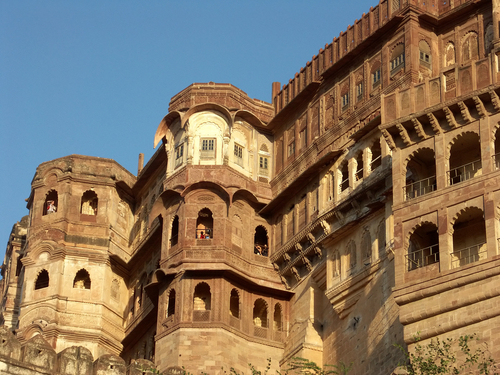
Rising out from a 410 ft high rock Mehrangarh is one of the majestic among the forts in Rajasthan. Mehrangarh's forbidding ramparts are in sharp contrast to the decorated palaces within. Founded in 1459 by Rao Jodha the sandstone fort was added to it by the later rulers mostly between the 17th - 19th centuries. The apartments within the fort now is a very beautiful museum. The Brahmapuri village clustered below the ramparts of the Mehrangarh fort are blue washed and it looks as beautiful sight from the heights. Havinga look at what all is in store at the Mehrangarh fort.
One of the most impressive sights in Rajasthan is the view of the blue city of Jodhpur from the ramparts of the Mehrangarh fort, built on a 125 metre high rock. There are several stories about the blue colour applied to the houses in the city. One is that it was used to mark the residences of the Brahmins, another is that it helped to cool the houses.
Actually the colour derives from copper sulphate which is mixed with the whitewash to repel termites and other insects. A winding road leads up to the fort from the city five kilometers below. The Mehrangarh fort sprawled across the entire hill is one of the most impressive and formidable fort in Rajasthan.
Its awesome location impressive gates palaces and numerous trappings of royalty are worth a visit. It provides the most authentic surviving taste of war, honour and extravagance that charaterised the royal Rajputana and is still maintained by the family of Gaj Singh the erstwhile Maharaja of Marwar - Jodhpur.
The lattice work on the buildings in the inner courtyard is intricate. Inside the Mehrangarh fort there are a series of courtyards and palaces. They house an extensive collection of trappings of the Rajput royalty including elephant howdahs, miniature paintings, folk music instruments, furniture, armoury and costumes.
On the walls of the Lohapol or iron gate of the sixth gate of the seven gates is designed to hinder the ascent of the enemy, are the handprints, the sati marks of Maharaja Man Singh's widows who voluntarily threw themselves on his pyre following the Rajput code of honour in 1843 and in defiance of the law passed against sati. Also there are the :
The ramparts
The walls of the fort are perched with cannons. Either walking down the whole fort or hiring the lift one reaches the top of the fort where one can see the cannons placed.
The Suraj pol is the entrance to the museum.
Nagnechiaji mandir
has a 14th century image of the goddess Kuldevi, the family diety of the rulers.
Shringar chowk
The coronation throne placed here is the of the Jodhpur rulers. It is made in white marble. All the rulers sat in this throne.
Moti Mahal
It was the hall of the private audience. It is a beautifully decorated room with mirrors, gold leaf, sea shells and so on.
Takhat Mahal
This room was the favourite of Maharaja Takhat Singh who had 30 queens and numerous concubines.
Sileh Khana's
exceptional collection of weapons include Mugal daggers, gem studded shields and special armour for war elephants.
Jai Pol
One of the seven fortified gates to the fort it is now the main entrance. It was built by Maharaja Man Singh to commemorate a vicyory in a battle.
Destinations in Rajasthan
Copyright © visitindia.org.in. All Rights Reserved.